
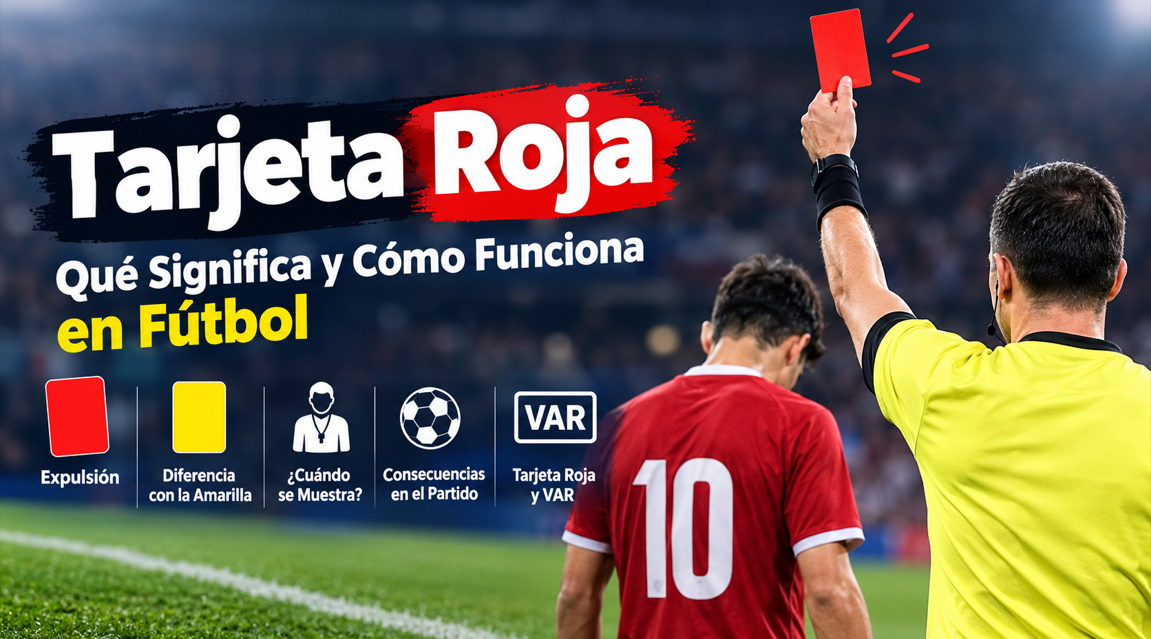
What Does Tarjeta Roja Mean in Football?
Tarjeta Roja is the Spanish term for red card in football or soccer. A referee shows the red card when a player commits an offense serious enough to require dismissal. The player must leave the field and cannot continue participating in that match.
The red card is one of the most recognizable disciplinary signals in football. It represents an expulsion, while a yellow card normally represents a caution. Understanding this distinction helps beginners follow referee decisions, match reports, football rules, and live-game commentary more easily.
- Spanish term: Tarjeta Roja
- English term: Red card
- Given by: Referee
- Main purpose: Player dismissal
- Applies during: Football matches
- Player must leave: Yes
- Further match participation: No
- Common alternative: Sending off
When Is a Tarjeta Roja Shown?
A Tarjeta Roja can be shown for serious misconduct under the applicable football Laws of the Game. The exact circumstances depend on the offense, but serious disciplinary incidents can result in immediate dismissal. A player may also be sent off after receiving two yellow cards in the same match.
Referees use cards to communicate disciplinary decisions clearly and consistently. A red card therefore does more than punish an individual player: it changes the number of players available to the team for the remainder of the match, creating an important tactical consequence.
- Serious foul play
- Violent conduct
- Certain handball offenses
- Denying a clear goal opportunity
- Offensive behavior
- Abusive language
- Two yellow cards
- Serious misconduct
Tarjeta Roja vs. Tarjeta Amarilla
The biggest difference between Tarjeta Roja and Tarjeta Amarilla is the consequence. A yellow card is a caution, allowing the player to remain in the match. A red card is an expulsion, meaning the player must leave the field and cannot return during that match.
A second yellow card in the same match can also result in a red card and dismissal. For beginners, remembering “yellow means caution, red means send-off” provides a simple starting point for understanding football discipline.
- Yellow card means caution
- Red card means dismissal
- Yellow-carded players may continue
- Red-carded players must leave
- Two yellows can produce red
- Both are shown by officials
- Cards enforce discipline
- Rules depend on competition regulations
What Happens After a Player Receives a Red Card?
After receiving a Tarjeta Roja, the player is sent off and cannot take part in the remainder of that match. The dismissal can significantly affect the team’s formation, defensive structure, attacking options, and tactical approach because the team has fewer players available on the field.
The player may also face additional disciplinary consequences after the match, depending on competition regulations and the nature of the offense. Possible sanctions can include a suspension for subsequent matches, although the exact punishment depends on the governing rules and circumstances.
- Player leaves the field
- Player cannot return
- Team continues with fewer players
- Tactical changes may follow
- Dismissed players are not normally replaced
- Officials record the incident
- Competition rules determine sanctions
- A later suspension may apply
Common Offenses That Can Lead to a Red Card
Football’s disciplinary framework distinguishes between ordinary fouls and more serious offenses. Actions involving serious foul play, violent conduct, or certain forms of denying a clear scoring opportunity can result in a sending-off. Referees assess incidents according to the applicable Laws of the Game.
Context matters when a referee makes a disciplinary decision. The location of an incident, the nature of the challenge, the scoring opportunity involved, and the player’s conduct can all be relevant when applying football’s rules.
- Serious foul play
- Violent conduct
- Serious misconduct
- Denial of a clear goal opportunity
- Certain deliberate handball offenses
- Second yellow card
- Abusive or offensive conduct
- Other dismissal offenses
How a Red Card Affects a Football Match
A Tarjeta Roja can immediately change the tactical balance of a game. With one fewer player, a team may reorganize its defensive shape, reduce attacking numbers, or adjust its midfield structure. Coaches often have to react quickly because the dismissal can alter how the remaining players approach the match.
The effect can be especially noticeable when a red card occurs early. A team may have to play for a substantial period with fewer players, requiring greater defensive organization and careful management of space. The opposing team may then have more opportunities to control possession and create attacks.
- Fewer players on the field
- Defensive shape may change
- Formation can be adjusted
- Attacking options may decrease
- Midfield coverage can change
- Possession patterns may shift
- Coaches may alter tactics
- Match strategy becomes more cautious
History and Importance of the Red Card
The use of colored cards made disciplinary decisions easier for players, officials, and spectators to understand. Red and yellow cards became an important part of international football culture, providing a clear visual language for cautions and dismissals. Their use became prominent in international football during the 1970 World Cup.
Today, the red card remains an important part of football officiating. Whether discussed as tarjeta roja, red card, expulsión, or sending off, the concept is widely understood across football communities and languages.
- Used internationally
- Provides visual disciplinary communication
- Shown by referees
- Recognized across football
- Connected with player dismissal
- Helps spectators understand decisions
- Appears in match statistics
- Remains part of modern football
Why Tarjeta Roja Matters to Football Fans
Understanding Tarjeta Roja makes it easier to follow match commentary, referee decisions, football statistics, and post-match analysis. When a commentator says a player has received a tarjeta roja, it means that player has been dismissed and will not continue participating in the match.
For beginners learning Spanish football vocabulary, Tarjeta Roja is also a useful phrase to know alongside tarjeta amarilla, árbitro, expulsión, falta, penalti, and partido. These terms frequently appear in football conversations, match reports, sports discussions, and football news.
- Learn Spanish football terminology
- Understand referee decisions
- Follow match commentary
- Recognize disciplinary statistics
- Understand player dismissals
- Distinguish red from yellow cards
- Follow tactical changes
- Improve football vocabulary