
What Is Easy Grader?
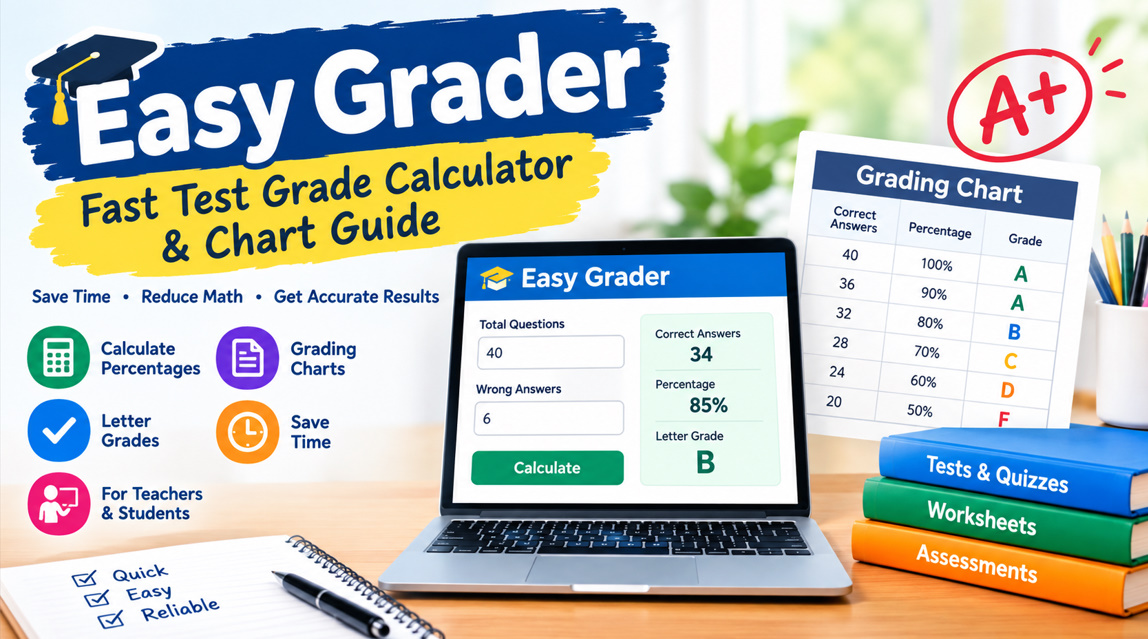
Easy Grader is a simple grading tool that helps teachers, students, and educators calculate test scores quickly. It can convert the number of correct or incorrect answers into a percentage and, depending on the grading scale, a letter grade. This makes routine assessment calculations easier and more efficient.
Instead of performing the same mathematical calculation for every test paper, users can rely on an easy grading system to determine results. Easy Grader is particularly useful for quizzes, classroom tests, worksheets, practice exams, and other assessments where questions have equal value.
- Test score calculator
- Quiz grade calculator
- Percentage calculator
- Classroom grading tool
- Easy score calculation
- Grade percentage tool
- Assessment calculator
- Teacher grading helper
How Does Easy Grader Work?
Easy Grader generally works by comparing the number of correct answers with the total number of questions. If a student answers 18 out of 20 questions correctly, the score is calculated by dividing 18 by 20 and multiplying the result by 100. This produces a percentage score of 90%.
When a grading scale is included, the calculated percentage can then be matched with the appropriate letter grade. The exact grade depends on the grading policy being used. Because grading systems can vary, users should always check the applicable academic grading scale.
- Enter total questions
- Count correct answers
- Identify incorrect answers
- Calculate the percentage
- Apply the grading scale
- Review the final score
- Check grade boundaries
- Record the result
Easy Grader Formula Explained
The basic EZ Grader formula is easy to understand. The percentage is calculated by dividing the number of correct answers by the total number of questions and multiplying by 100. If you know the number of incorrect answers instead, subtract them from the total questions to find the correct-answer count.
For example, a test with 25 questions and 5 incorrect answers has 20 correct answers. The calculation is 20 divided by 25, multiplied by 100, resulting in an 80% score. This simple formula makes manual grading possible even without an automated calculator.
- Correct answers = total questions − wrong answers
- Percentage = correct ÷ total × 100
- Use accurate numbers
- Count questions carefully
- Check calculations twice
- Confirm the total score
- Review unusual results
- Follow the grading policy
Benefits of Using Easy Grader
One major benefit of Easy Grader is time savings. Teachers who regularly grade quizzes and tests may need to calculate dozens or even hundreds of scores. A grading calculator reduces repetitive arithmetic and allows educators to focus more attention on teaching, feedback, and student progress.
Easy Grader can also improve consistency. When the same formula and grading scale are applied to every student, the calculation process becomes easier to standardize. This can reduce common arithmetic mistakes and make score checking more convenient for both educators and learners.
- Saves grading time
- Reduces calculation errors
- Improves consistency
- Simplifies score checking
- Supports classroom assessments
- Helps with quizzes
- Makes grading convenient
- Speeds up feedback
Easy Grader for Teachers
Teachers can use Easy Grader to simplify everyday assessment tasks. After creating a quiz or test, an educator can determine the score associated with each possible number of correct answers. This is particularly convenient when multiple students complete the same assessment and each question has equal value.
A grading chart can make the process even faster. Instead of calculating every percentage separately, teachers can refer to the appropriate score range. This approach is useful for classroom tests, worksheets, homework checks, practice assessments, and other educational activities.
- Grade classroom tests
- Check quiz results
- Create score charts
- Calculate percentages
- Reduce repetitive work
- Standardize grading
- Check student performance
- Record assessment results
Easy Grader for Students
Students can use Easy Grader to better understand their academic results. After completing a practice test or quiz, they can calculate the percentage represented by their correct answers. This provides a quick way to understand performance and identify areas that may require additional study.
Understanding how scores are calculated can also help students become more comfortable with percentages and grading systems. However, students should remember that an individual test percentage may not represent their complete course grade because different assignments can have different weights.
- Check practice scores
- Calculate test percentages
- Understand letter grades
- Review mistakes
- Track academic progress
- Identify study areas
- Prepare for future tests
- Understand grading systems
Easy Grader Charts and Letter Grades
An Easy Grader chart can display different numbers of correct answers alongside their corresponding percentages. For example, on a 20-question test, every possible number of correct answers represents a specific percentage. A chart allows users to find the required score without repeatedly performing the same calculation.
Letter grades are determined by the grading scale selected by a school, teacher, or institution. A common system may classify scores from 90% to 100% as an A, but grading policies can differ. Therefore, users should always apply the correct grading criteria for their assessment.
- Percentage grading
- A–F grading scale
- Custom grade boundaries
- Score lookup chart
- Correct-answer ranges
- Passing-score requirements
- Plus and minus grades
- School grading policies
Tips for Accurate Easy Grading
Accurate results depend on entering the correct information. Before calculating a score, confirm the total number of questions and verify the number of incorrect or correct responses. A small input mistake can produce an incorrect percentage, so reviewing the information before recording the grade is important.
Simple Easy Grader calculations work best when every question has the same value. If an assessment includes weighted sections, partial credit, bonus questions, or questions worth different points, a points-based grading method may be more suitable. Always follow the assessment’s official scoring rules.
- Verify total questions
- Count answers carefully
- Check incorrect responses
- Confirm grade boundaries
- Review final percentages
- Consider weighted questions
- Account for bonus points
- Keep grading records accurate